Compare Pool Tile Replacement Services: Contractor & Engineering Guide
Replacing the waterline tile on an in-ground swimming pool represents far more than a routine aesthetic face-lift. Positioned precisely at the intersection of water chemistry, atmospheric exposure, and structural concrete movement, the waterline tile band functions as a primary defensive barrier. It protects the porous concrete bond beam against continuous thermal cycling, freeze-thaw expansion, chemical erosion, and hard-water scaling. When property owners evaluate contractors to execute this critical intervention, they face a landscape dominated by vastly different operational models, varying material standards, and inconsistent substrate preparation methods.
Evaluating tile restoration proposals requires analyzing sub-surface civil engineering principles, material science, and trade governance. A contractor proposing a low-cost tile overlay often leaves fractured concrete beams, active rebar rust, and deteriorating waterproof membranes untouched. Conversely, an engineering-grade contractor approaches tile replacement as a complete structural perimeter overhaul—demolishing degraded concrete back to sound aggregate, applying elastomeric waterproofing membranes, and setting non-porous glass or porcelain tiles with modified polymer mortars.
Consequently, attempting to evaluate competing proposals based solely on initial cost estimates creates significant long-term financial risk. Failing to evaluate contractor qualifications, mortar specifications, and beam prep protocols frequently results in sheared tile bands, sub-deck water intrusion, and premature plaster delamination. This guide establishes a comprehensive, analytical reference framework to help facility managers, structural consultants, and homeowners systematically evaluate tile replacement contractors, ensuring long-term structural resilience and operational durability.
Understanding “compare pool tile replacement services”
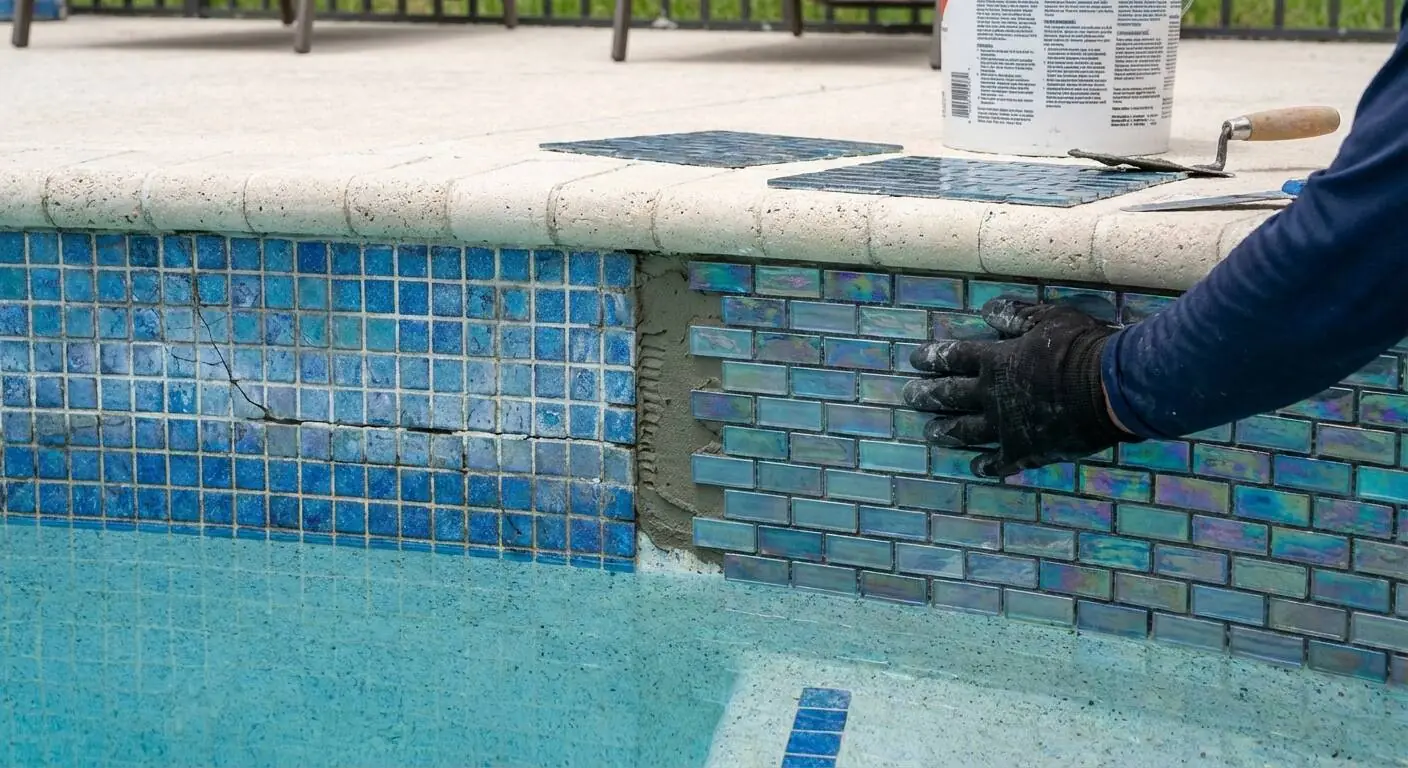
To effectively compare pool tile replacement services, decision-makers must move past simple price-per-linear-foot metrics and examine the structural, waterproofing, and setting methodologies proposed by competing firms. On the surface, two proposals may specify identical ceramic or glass tiles. However, their execution protocols can differ fundamentally in substrate chipping depth, structural beam repair, expansion joint construction, and mortar matrix chemistry.
Evaluating service providers requires categorizing contractors based on their core technical capabilities and labor structures. The market consists of high-volume plaster applicators who treat tile installation as a secondary task, independent masonry sub-contractors, specialized tile restoration experts, and full-service aquatic engineering firms. Therefore, attempting to compare pool tile replacement services without accounting for these differing operational profiles leads to severe misalignments between owner expectations and long-term field performance.
Four Core Dimensions of Service Evaluation
A rigorous evaluation of tile replacement proposals requires analyzing four interconnected structural and administrative vectors:
-
Substrate Preparation and Beam Rehabilitation: Evaluating whether the contractor’s scope includes pneumatic chipping back to solid concrete, rebar rust isolation, and structural grout rebuilding, rather than tiling over fractured substrate.
-
Waterproofing and Membrane Integration: Verifying the application of continuous elastomeric waterproofing membranes behind the tile matrix to block water migration into the concrete bond beam.
-
Adhesive and Setting Chemistry Specifications: Ensuring setting mortars and grouts utilize polymer-modified or epoxy formulations engineered specifically for submerged, high-alkalinity aquatic environments.
-
Expansion Joint and Deck Isolation Governance: Confirming the creation of a continuous, elastomeric expansion joint between the pool coping stone and the surrounding deck to absorb soil-driven lateral movement.
Focusing exclusively on decorative tile aesthetics distorts the evaluation process. A sound assessment prioritizes sub-surface structural integrity and waterproofing long before evaluating tile colors or patterns.
Deep Contextual Background: Evolution of Waterline Tile Systems
Understanding the technological and methodological evolution of waterline tile installations provides essential context when you compare pool tile replacement services.
The Standard Ceramic Era (1960s–1980s)
During the mid-to-late 20th century, residential pool construction relied almost exclusively on 6×6-inch glazed ceramic tiles set directly over thick mortar beds. Tile installation was straightforward, relying on standard Portland cement mixtures without synthetic polymer modifiers. Waterlines functioned primarily to conceal oil and scum lines, which were difficult to clean from porous marcite plaster.
However, because these early cement settings lacked flexibility and moisture resistance, thermal expansion cycles and hard-water scale accumulation led to frequent tile debonding. Furthermore, early installations rarely incorporated dedicated deck-to-coping expansion joints, leading to widespread horizontal shear cracking along top bond beams.
The Shift to Frost-Proof Porcelains and Mosaics (1990s–2000s)
As freeze-thaw structural damage became better understood in northern climates, tile manufacturing shifted toward low-absorption frost-proof porcelain tiles and smaller 1×1-inch mosaic sheets. Polymer-modified thinset mortars emerged, improving bond shear strength and providing minor resistance to structural vibration.
During this period, however, the industry experienced a boom in subcontracted labor. General pool builders increasingly outsourced tile setting to piece-rate masonry crews who often bypassed structural beam prep to maximize installation speed. Consequently, property owners seeking to compare pool tile replacement services encountered vast differences between contractor sales promises and actual jobsite waterproofing standards.
The Modern Glass Tile and Engineering Era (2010s–Present)
Today, waterline tile replacement has evolved into a specialized trade heavily influenced by advanced glass tile manufacturing and high-performance epoxy chemistry. Glass tiles feature zero porosity and high thermal expansion coefficients, requiring specialized elastomeric thinset mortars and two-part epoxy grouts to absorb thermal stress without cracking.
Furthermore, modern building codes and structural standards require complete deck isolation joints and elastomeric waterproofing barriers. As a result, evaluating tile replacement services today demands a thorough assessment of a contractor’s material literacy, surface prep rigor, and structural waterproofing experience.
Conceptual Frameworks and Mental Models for Service Evaluation
Applying structured evaluation frameworks prevents emotional decision-making and ensures an objective assessment of competing tile replacement quotes.
1. The Substrate Bond Shear Strength Model
The bond strength between the concrete shell, setting mortar, and tile dictates installation lifespan:
Applying new tile over smooth, un-chipped concrete or old mortar yields low mechanical shear strength. Conversely, executing a pneumatic chip-out to achieve an ICRI Concrete Surface Profile (CSP) of 3 to 5, followed by a polymer-modified scratch coat, maximizes mechanical keying and long-term bond strength.
2. The Deck Thrust Isolation Principle
Surrounding concrete decks expand horizontally during warm weather, exerting immense lateral force against the back of the pool coping stone. Without a functional expansion joint filled with flexible foam backer rod and elastomeric polyurethane sealant, lateral deck movement transfers directly into the pool beam. This “deck thrust” causes tile lines to shear, crack, and pop off the wall regardless of mortar quality.
3. The Moisture Vapor Transmission (MVT) Barrier Model
Concrete bond beams are porous structures through which groundwater migrates due to vapor pressure differentials:
If water penetrates behind the tile matrix, freeze-thaw cycles convert trapped liquid into ice, expanding by roughly 9% in volume. This hydraulic expansion pops tiles off the substrate. Installing a continuous, fluid-applied elastomeric waterproofing membrane over the prepared beam blocks moisture intrusion and protects the setting bed.
Key Categories of Tile Replacement Service Providers and Trade-Offs
When property owners compare pool tile replacement services, they must recognize that service providers operate under fundamentally different business models. Each model presents distinct trade-offs regarding cost, schedule, specialized skill, and structural durability.
1. High-Volume Plaster and Resurfacing Contractors
Firms focused primarily on full-pool plastering and pebble applications that offer tile replacement as an add-on service.
-
Strengths: Competitive bundled pricing, fast project completion, single-contractor convenience during full pool remodels.
-
Trade-offs: Often treat tile setting as secondary work; frequently use standard ceramic mortars rather than specialized glass-tile epoxies; limited beam repair capabilities.
2. Specialized Aquatic Tile and Restoration Contractors
Trade contractors dedicated exclusively to waterline tile replacement, glass tile installation, and bond beam structural repairs.
-
Strengths: Deep mastery of glass tile setting, advanced waterproofing techniques, structural beam rebuilding, and custom coping integration.
-
Trade-offs: Premium labor rates, longer scheduling lead times, narrow service focus (may not handle main filtration or plastering).
3. General Masonry and Hardscape Crews
Independent masonry workers who execute stone coping, paver patios, and basic ceramic pool tile setting.
-
Strengths: Excellent natural stone cutting skills, competitive day-labor pricing, strong deck-to-coping integration capabilities.
-
Trade-offs: Often lack specialized knowledge regarding submerged chemistry, non-porous glass tile adhesives, waterproofing membranes, and underwater concrete behavior.
4. Full-Service Aquatic Engineering and Design-Build Firms
Turnkey contractors managing structural shell modifications, deep hydraulic re-piping, decking, and architectural tile design.
-
Strengths: Single point of accountability, comprehensive engineering capabilities, thorough site management, robust warranty backings.
-
Trade-offs: Highest overall capital investment, substantial overhead markup, formal project scheduling timelines.
Contractor Category Operational Matrix
Detailed Real-World Evaluation Scenarios, Structural Constraints, and Risks
Examining practical evaluation scenarios demonstrates how differing contractor qualifications directly impact installation outcomes when you compare pool tile replacement services.
Scenario 1: Sheared Glass Tile Line over a Fractured Concrete Beam
Site Constraints
A 20-year-old concrete pool exhibits horizontal beam cracking along a 40-foot tile section, accompanied by loose, delaminated 1×1-inch glass tiles. The surrounding concrete deck sits directly against the coping stone with no expansion joint present.
Contractor Proposal Comparison
-
Contractor A (Volume Resurfacing Firm): Proposes scraping off loose tile, filling beam cracks with standard hydraulic cement, and setting new ceramic tile using standard polymer thinset. Cost: $3,200.
-
Contractor B (Specialized Tile Restoration Firm): Proposes demolishing tile and coping, chipping fractured concrete down to sound rebar, treating exposed steel with zinc anti-corrosion coatings, re-pouring the beam with non-shrink structural grout, applying a two-coat fluid elastomeric waterproofing membrane, installing glass tile using two-part epoxy thinset and grout, and cutting a full 0.75-inch deck-to-coping expansion joint. Cost: $8,500.
Analysis & Failure Mode
Contractor A’s proposal ignores the root cause of the failure: lateral deck thrust and an unwaterproofed, fractured beam. Choosing Contractor A will result in the horizontal beam crack telegraphing through the new mortar, shearing the glass tile line within 12 to 18 months. Contractor B’s quote addresses the structural cause, ensuring long-term stability.
Scenario 2: Waterline Tile Replacement in a Freeze-Thaw Climate
Site Constraints
A residential pool in Chicago experiences severe winter freeze-thaw cycles. The existing ceramic tiles absorb water, causing glaze pop-offs and severe mortar degradation each spring.
Contractor Proposal Comparison
-
Contractor A (General Masonry Crew): Quotes setting standard glazed ceramic tile with traditional Portland cement thinset mortar and standard sanded grout. Cost: $4,000.
-
Contractor B (Specialized Restoration Firm): Specifies zero-absorption frost-proof porcelain tile set with polymer-modified submerged-grade thinset, coupled with fully solid-epoxy grout joints to prevent water absorption and ice expansion. Cost: $6,800.
Analysis & Failure Mode
Contractor A’s material selection invites water absorption into the tile body and mortar bed. During winter freezes, trapped water expands, blowing the tile faces off the wall. Contractor B’s specification eliminates water absorption paths, ensuring winter freeze resistance.
Planning, Cost, and Resource Dynamics
Evaluating costs requires analyzing direct labor, material specifications, site preparation prep, and long-term maintenance overhead.
Capital Allocation Dynamics
-
Direct Material Expenses (25–35%): Frost-proof porcelain or glass tile sheets, polymer-modified thinsets, two-part epoxy grouts, and elastomeric waterproofing compounds.
-
Demolition and Substrate Preparation Labor (35–45%): Pneumatic concrete chipping, rebar rust isolation, surface grinding, structural grout re-building, and debris disposal.
-
Waterproofing and Expansion Joint Execution (15–20%): Membrane application, foam backer rod placement, and polyurethane sealant joint injection.
-
Administrative and Contingency Reserves (10–15%): Site access setup, utility locating, water lowering, and underground beam repair contingencies.
Industry Cost Ranges by Service Scope
Tools, Diagnostic Strategies, and Substrate Prep Systems
Before signing a tile replacement contract, property owners should require contractors to execute diagnostic evaluations to establish precise jobsite baselines.
Essential Diagnostic Protocols
-
Acoustic Sounding Rod Inspections: Tapping the concrete bond beam with steel rods to identify hollow, delaminated concrete beneath old mortar beds via pitch changes.
-
Sub-Surface Rebar Scanners: Locating buried steel reinforcement cages to identify areas with low concrete cover prone to rust spalling.
-
Laser Slope and Level Verifications: Checking coping and beam alignment to ensure proper drainage away from the tile face.
-
Impulse Radar Void Mapping: Identifying voids underneath surrounding concrete decks created by historic waterline leaks.
Substrate Preparation Methodologies
-
Pneumatic Chipping Hammers: Handheld pneumatic tools used to strip degraded mortar and cracked concrete back to solid aggregate without micro-fracturing the beam.
-
Abrasive Diamond Grinding: Mechanical surface grinding to remove old coatings, algae, and scale, achieving an ideal surface profile for waterproofing adhesion.
-
Fluid-Applied Elastomeric Membranes: Flexible waterproofing coatings brushed or rolled over prepared concrete to block moisture intrusion.
Risk Landscape, Contractor Failure Modes, and Liability Management
Evaluating tile replacement services requires identifying how mechanical, chemical, and environmental stresses cause installation failures.
Primary Contractor Failure Modes
-
Omission of Deck Expansion Joints: Failing to maintain or cut a continuous expansion joint between the coping stone and surrounding deck allows lateral deck thrust to shear the tile band.
-
Improper Mortar Coverage (Comb Voiding): Troweling thinset without flattening mortar ridges leaves hollow air voids behind tiles. Trapped water in these voids freezes in winter, popping tiles off the beam.
-
Incompatible Thinset Chemistry on Glass Tile: Using standard ceramic thinset on non-porous glass tiles results in weak chemical bonding, causing widespread tile debonding within 1 to 3 years.
-
Sub-Contractor Payment Lien Exposures: Failing to collect conditional and unconditional lien waivers exposes property owners to mechanic’s liens if contractors fail to pay material suppliers.
Governance, Contractual Protections, and Quality Assurance
Protecting a capital investment in tile replacement requires establishing structured contractual governance terms before work begins.
Key Contractual Protections
-
Mandatory Lien Waiver Protocols: Require contractors to provide signed Conditional Lien Releases with each progress payment, followed by Unconditional Lien Releases upon final payment.
-
Detailed Material Specification Clauses: Ensure contracts explicitly state exact tile brand names, model numbers, thinset series numbers, and grout chemical types rather than vague placeholders.
-
Milestone-Based Payment Schedules: Align payments with verified field milestones (e.g., 10% at signing, 30% post-demolition and beam prep inspection, 30% post-waterproofing and tile setting, 30% upon final inspection and joint sealing).
-
Submerged Workmanship Warranty Terms: Secure written workmanship warranties that cover both labor and materials for tile debonding and beam cracking for a minimum of 3 to 5 years.
Measurement Metrics and Performance Evaluation Signals
Property owners should monitor clear leading and lagging indicators during and after tile replacement to verify quality execution.
Diagnostic Metrics Checklist
-
Leading Indicators (During Construction):
-
Verification of 100% mortar coverage behind tiles (achieved via back-buttering tiles and collapsing trowel ridges).
-
Verification that fluid waterproofing membranes cure to specified dry-film thickness before setting tile.
-
Confirmation of a continuous 0.5-to-0.75-inch expansion joint gap between coping and deck.
-
-
Lagging Indicators (Post-Construction):
-
Zero hollow sounds during annual acoustic sounding inspections along the tile line.
-
Absence of calcium efflorescence leaching through grout joints.
-
Stable grout line integrity with zero hairline cracking along thermal transition zones.
-
Common Misconceptions and Industry Oversimplifications
1. “Glass tile can be set using standard pool thinset mortar.”
Correction: Glass tile is non-porous and experiences higher thermal expansion than ceramic tile. Setting glass tile requires specially formulated, highly polymer-modified elastomeric thinsets or two-part epoxies engineered to grip non-porous glass surfaces.
2. “Tile popping is always caused by bad setting mortar.”
Correction: In most cases, tile debonding is caused by sub-surface structural issues—such as horizontal beam cracking, lack of an expansion joint (deck thrust), or freeze-thaw expansion of water trapped behind the setting bed.
3. “Waterline tile is purely decorative.”
Correction: Waterline tile serves as a crucial waterproof barrier that protects the porous concrete bond beam against chemical erosion, water absorption, and freeze-thaw spalling at the water-air interface.
4. “Epoxy grout eliminates the need for waterproofing membranes behind the tile.”
Correction: While epoxy grout is impermeable, water can still migrate into the bond beam from behind the coping stone, from surrounding soil, or through micro-cracks along the plaster interface. A continuous waterproofing membrane behind the setting bed remains essential.
Ethical, Environmental, and Regulatory Compliance Considerations
Modern tile replacement projects operate under increasing environmental oversight regarding dust containment, chemical disposal, and worker safety.
Environmental and Regulatory Requirements
-
Silica Dust Containment Compliance: Pneumatic concrete chipping and diamond grinding generate hazardous respirable crystalline silica dust. Contractors must utilize HEPA-filtered vacuum attachments and wet-cutting methods to comply with OSHA safety standards.
-
Chemical Disposal Regulations: Rinsing epoxy tools or disposing of uncured thinset wash water into municipal storm drains violates environmental laws. Contractors must capture and neutralize jobsite wash water.
-
Pool Drainage and Discharge Laws: Lowering pool water below the tile line requires discharging chemically treated water according to local environmental rules, preventing high-salinity or chlorinated water from entering local waterways.
Conclusion
Systematically evaluating pool tile replacement services requires analyzing structural repair methods, waterproofing integrity, and setting chemistry rather than comparing surface-level price estimates. A successful tile restoration depends on selecting a contractor who addresses underlying concrete beam damage, installs continuous waterproofing barriers, and uses setting materials engineered for submerged aquatic environments.
When decision-makers systematically compare pool tile replacement services across structural, waterproofing, and chemical metrics, they protect their capital investments against premature degradation. Choosing an engineering-grade contractor ensures that renovated waterline tile bands deliver long-term structural protection, low maintenance overhead, and lasting visual quality for decades to come.